Discipline and Disability in New York City Public Schools
Looking at the U.S. Office for Civil Rights data for New York City public schools entitled “Discipline and Disability” (Figures 1 and 2) and thinking in particular about expulsion and other forms of removal, the question that came to mind was: How often are students with disabilities expelled, referred to law enforcement, or transferred to alternative schools for disciplinary reasons, and how does this data change based on the student’s race/ethnicity and their gender?
What the data show
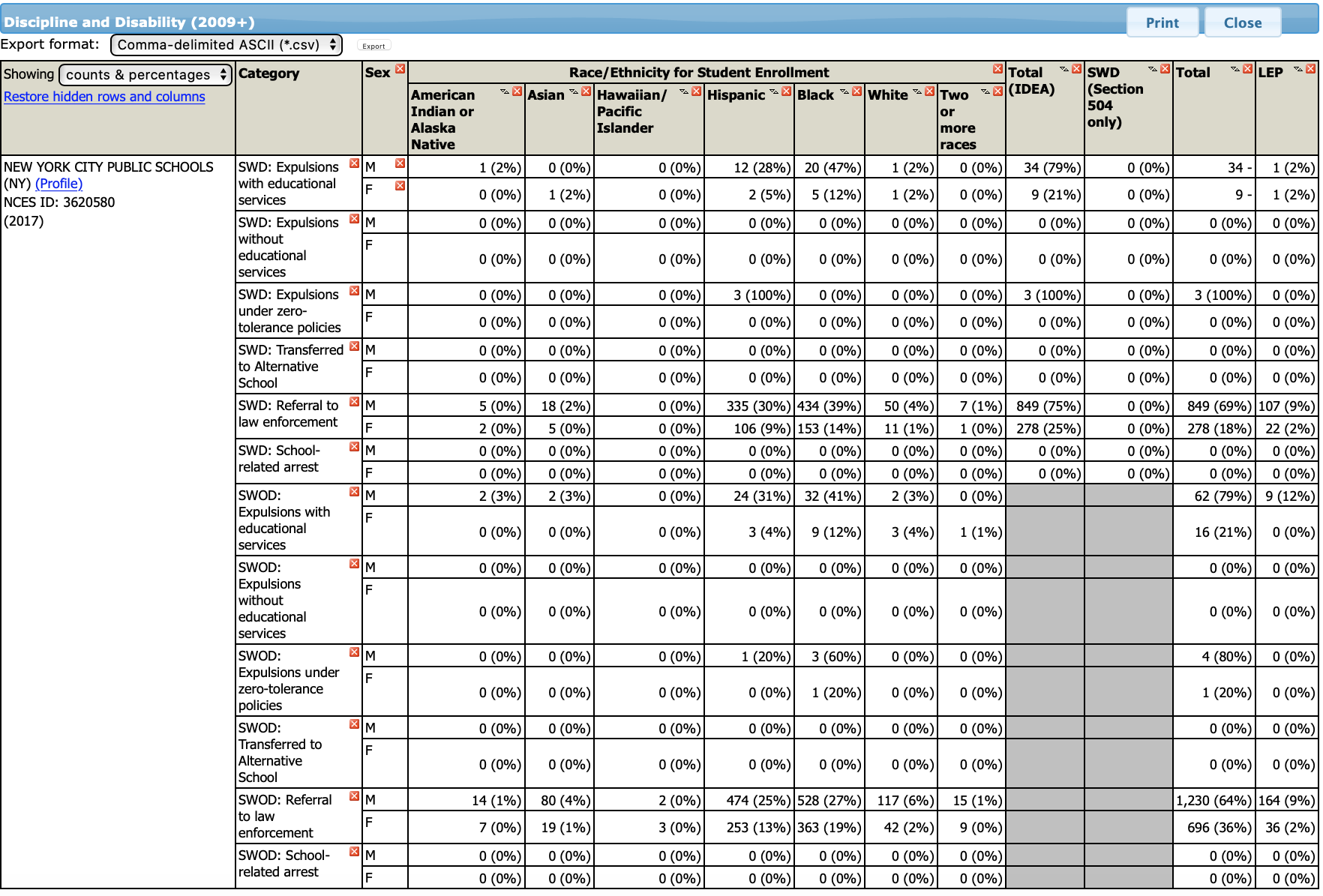
Discipline and disability, New York City Public Schools. Source: Civil Rights Data Collection, 2017.

Enrollment, New York City Public Schools. Source: Civil Rights Data Collection, 2017.
It is easiest to begin to disaggregate the data by first addressing categories for which male and female students of all races and ethnicities with and without disabilities reported 0% occurrence: expulsions without educational services, transferal to alternative school, and school-related arrests. More will be said about this data—and the question of 0% occurrence—but it is helpful first to outline some of the other numbers and point to particular intersections of race, disability, and gender; looking at expulsions under zero-tolerance policies, expulsions with educational services, and referrals to law enforcement, there is a disproportionality with regard to male students with disabilities—in particular, male Hispanic and Black students with disabilities. (Hispanic students as a whole are not overrepresented in referrals to law enforcement or expulsions with educational services relative to their 41% of enrollment, so for Hispanic male students with disabilities, the disproportionality tracks disability and sex rather than ethnicity; Black students, at 23% of enrollment, account for roughly half of both.) Looking at expulsions under zero-tolerance policies, 37.5% of students who experienced this were students with disabilities, pointing already to disproportionate representation, insofar as students with disabilities represent 20% of the students enrolled in New York City public schools (Figure 2). To look more closely, 100% of students with disabilities expelled under these conditions were identified as Hispanic male students (3 students in all). Of the students without disabilities expelled under zero-tolerance policies, 20% were identified as Hispanic male students (1 student), 60% as Black male students (3 students), and 20% as Black female students (1 student). Even given the smaller sample size, this data points to the aforementioned broader trend; namely, a disproportionate representation of male students with disabilities (here, Hispanic male students with disabilities in particular). Turning to students expelled with educational services, it is helpful to begin by pointing out that 43 (34 male and 9 female) students with disabilities experienced this, compared to 78 (62 male and 16 female) students without disabilities, speaking again to a disproportionality in terms of both disability and sex, insofar as male students with disabilities’ representation exceeds expectations for the group. Black male students with disabilities in particular constituted 16.5% of those students who were expelled with educational services, which is much greater than the percentage that would be expected if this data were proportional, given that Black male students with or without disabilities make up approximately 12% of New York City public schools students (and Black male students with disabilities a smaller share still). Looking at referrals to law enforcement, similar trends arise. In 2017–18, 849 male and 278 female students with disabilities were referred to law enforcement, compared to 1,230 male and 696 female students without disabilities. Not only are male students overrepresented in this data, then, but so are students with disabilities and male students with disabilities in particular. Approximately 14.2% of the referrals to law enforcement were for Black male students with disabilities.
Questions the data raise
Given all of this information, a number of questions come to mind. At the most basic level, I wonder if schools are underreporting data, thereby obscuring the full extent of the problems of lost instructional time and the disproportionate impact this has on Black and Hispanic male students with disabilities. This question comes primarily from seeing the data reporting zero school arrests and from reading Lost Opportunities: How Disparate School Discipline Continues to Drive Differences in the Opportunity to Learn. As Losen and Martinez point to, “[g]iven that referrals to law enforcement must, by definition, include all calls to police about student misconduct as well as all school-related arrests, the widespread failure to report the data on arrests means that the referral to law enforcement and school-related arrest data are likely inaccurate and underreported” (Losen & Martinez viii); they also mention that there are higher percentages of missing data from districts serving at least 500 Black secondary students (Losen & Martinez 36). The racial gap they identify, in other words, is likely even more pronounced. Thinking in terms of the intersection of race, gender and disability and the way in which students are “subject to discrimination on the basis of both race, gender, [disability], and often, a combination” (Coaston), that gap would become more pronounced. I have similar questions about gaps in data related to transferring students to alternative schools, particularly in light of Lost Opportunities’ discussion on another way in which data can be altered by school districts:
One concern is that school districts that do not replace harsh policies may give the appearance that they are reducing their use of suspensions, but rather than making improvements, they are instead relying on disciplinary removal to alternative schools or finding other ways to remove students, such as referring them to law enforcement while not issuing a suspension. (Losen & Martinez vii)
All of this in my mind points to two things: more time out of school (including both instructional time and, as the report says, crucial in-school services) and a perpetuation of a system of mass incarceration through a “school to prison pipeline” for lack of a better term, disproportionately affecting the same communities.
School- and teacher-level strategies
The first teacher- and school-level strategies that come to mind in addressing expulsions and other removals of students through transferals to alternative schools for behavioral reasons and through law enforcement involve advocating for and implementing an overhaul of disciplinary codes. The report discusses the way in which principals’ attitudes in particular correlate with the levels of exclusionary discipline in the school, thereby exacerbating the disproportionate impact of such policies. At a baseline level, then, if the district will not implement policy to eliminate their use, I think of how to work to change principals’ and teachers’ attitudes—not a simple task, but one that perhaps could be begun through examination of data. I think there could also be training on initiatives like PBIS and trauma-informed practices to equip schools with ways of addressing behavior in the classroom and in the school. Perhaps this would be a space where community partnerships could be forged, more counselors could be hired, and more social workers and mental health professionals could be brought in to support all members of the school community.
Student- and family-level strategies
I paused writing this for a while when trying to think of student- and family-level strategies that could contribute to reducing the problem, because I think so often what I’ve heard messaged—particularly growing up in Missouri, whose abysmal track record was alarming but unsurprising reading Lost Opportunities—has been a type of blaming of families and students. But having grown up in St. Louis, what also comes to mind is the grassroots Black activism that has always been present in the city, and that gained broader national and international attention in the wake of Darren Wilson’s killing of Mike Brown and with the Black Lives Matter movement. This past summer, then, after Derek Chauvin murdered George Floyd, I heard a lot of national political discourse around “counselors, not cops,” something that speaks to many of the points in Lost Opportunities. I recently saw social media posts about the way Los Angeles is moving towards this by reallocating portions of its budget, but the way that New York has instead funded more police in schools. What comes to mind, then, is the role of continuing community activism on district and local levels and the integral role students and their families play in this. Given that, “when police are in our schools, they either get directly involved in routine school discipline or their presence indirectly contributes to a harsher, more exclusionary climate” (Losen & Martinez 34), this perhaps would have a bearing on both referrals to law enforcement/school-related arrests and expulsions.
Works Cited
- Civil Rights Data Collection (2017). Discipline and Disability [Data set]. Office for Civil Rights. https://ocrdata.ed.gov/flex/Reports.aspx?type=district
- Coaston, J. (2019, May 28). The intersectionality wars. Vox. https://www.vox.com/the-highlight/2019/5/20/18542843/intersectionality-conservatism-law-race-gender-discrimination
- Losen, D. & Martinez, P. (2020). Lost Opportunities: How Disparate School Discipline Continues to Drive Differences in the Opportunity to Learn. UCLA. https://escholarship.org/uc/item/7hm2456z